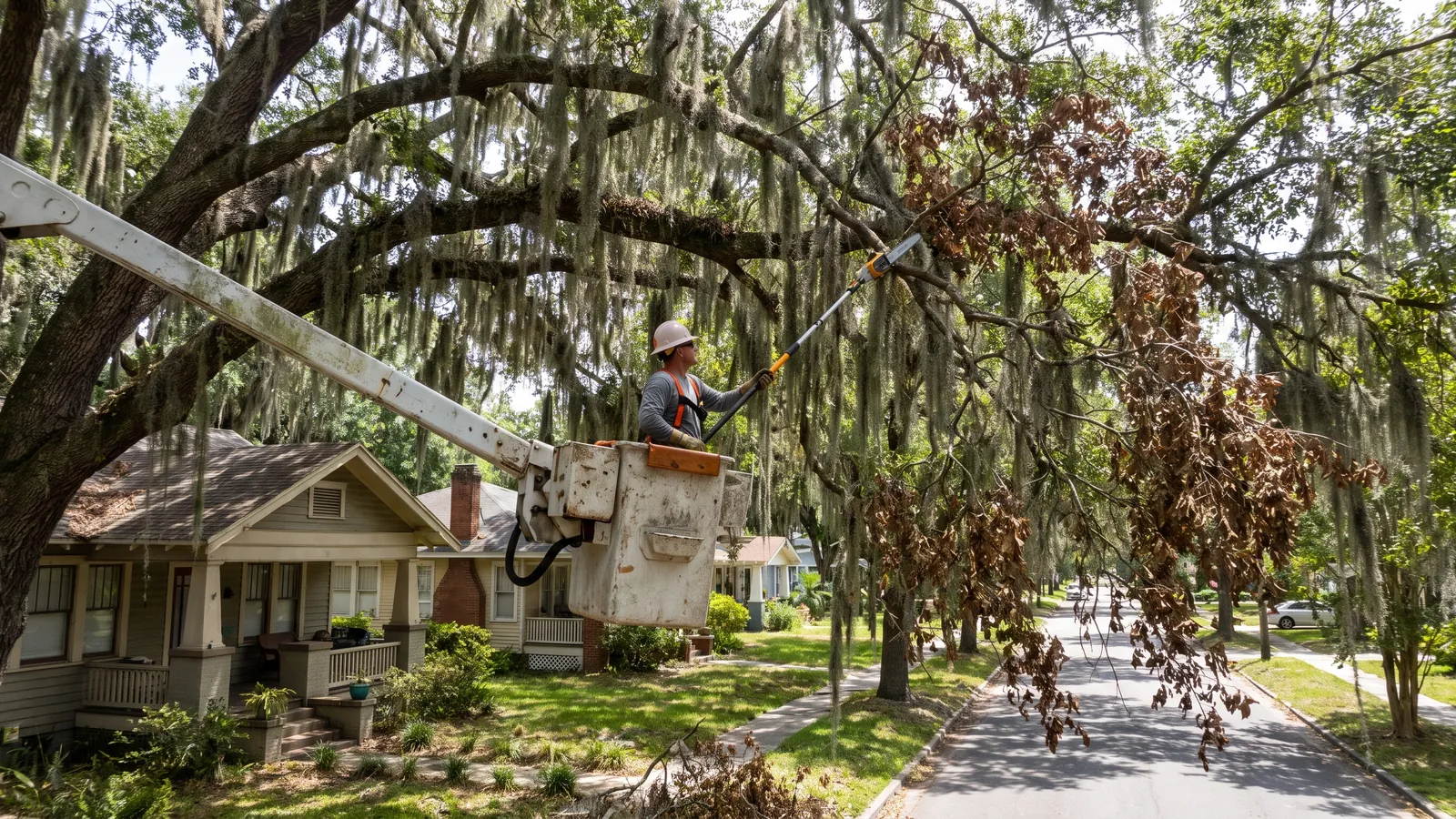
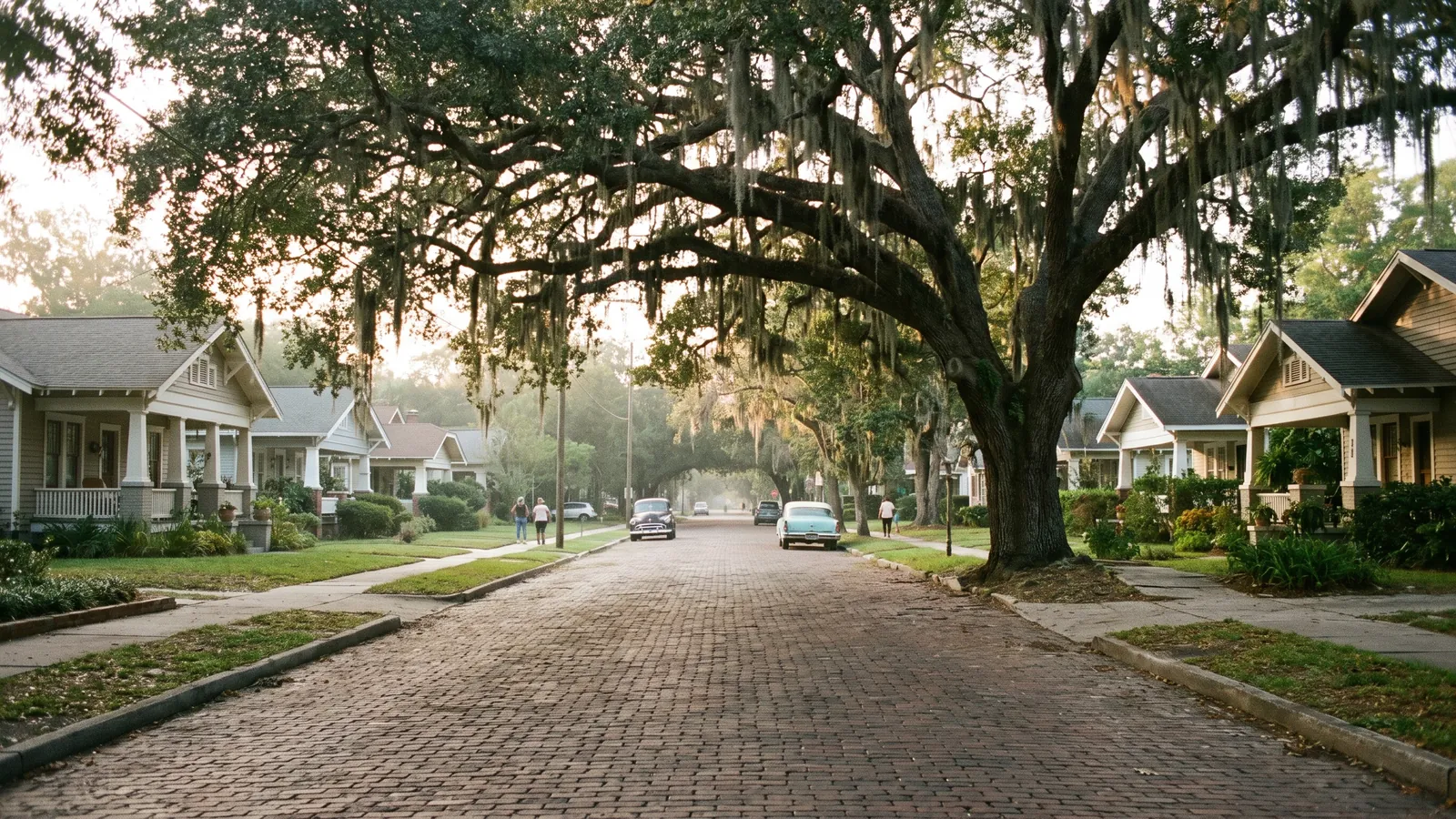
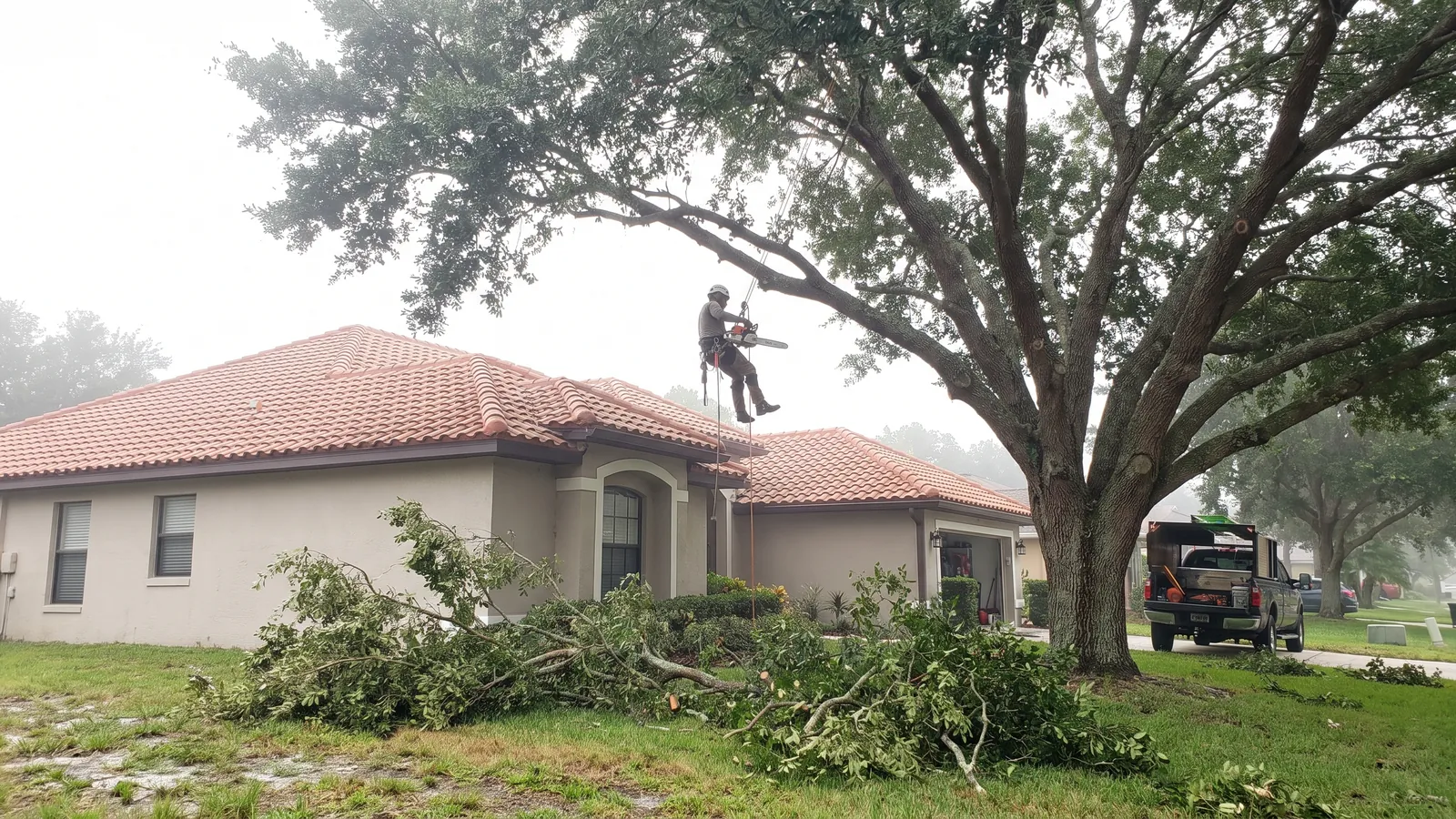
Most of the trimming we do in Lakeland is maintenance on trees that are worth keeping: deadwooding the century live oaks in Dixieland and Beacon Hill so the dead limbs come down on our schedule instead of a storm's; cleaning and thinning crowns so wind moves through them; raising canopies off roofs, driveways and the brick streets; clearing the service drop from the pole to the house; and structural pruning on young trees so they grow a strong central leader and well-spaced limbs instead of the weak, co-dominant forks that split at twenty. Every cut follows the ISA's pruning standard (ANSI A300): at the branch collar, never flush, never a stub, and never more than a quarter of the live crown in a year.
What we don't do is top trees. Topping — cutting the main limbs back to stubs — is still common in Polk County and it's the worst thing you can do to an oak: the stubs rot, the tree pushes out a thicket of weakly-attached water sprouts that grow fast and break easily, and in ten years you have a bigger, more dangerous tree than you started with. We also don't lion-tail (strip the interior and leave tufts at the tips), which loads the ends of the limbs and sets them up to break. If you've been told your oak needs to be topped for hurricane safety, call us for a second opinion; what it usually needs is a proper thin and a weight reduction, which is a different job.
What's included
Deadwooding
Dead and dying limbs removed before a storm removes them — the single best thing for an old oak.
Crown cleaning & thinning
Crossing, rubbing and crowded limbs removed so wind moves through the canopy instead of pushing on it.
Clearance
Roofs, gutters, pool cages, driveways, the service drop and the street — raised to code and kept there.
Weight reduction
Overextended limbs over the house shortened back to a lateral, not stubbed.
Structural pruning
Young oaks and maples trained to one leader and sound branch spacing so they never need a crane.
Never topping
ANSI A300 cuts at the collar, under a quarter of the live crown, and an explanation of every cut.
Tree trimming cost in Lakeland, FL
| Job | Typical price | Notes |
|---|---|---|
| Small tree trimming, under 30 ft | $100 – $400 | Crape myrtle, young oaks, ornamentals |
| Medium tree, 30–60 ft | $400 – $800 | Most maintenance pruning |
| Large tree, 60 ft and up | $700 – $1,500 | Mature oaks and pines |
| Live oak crown cleaning, big historic tree | $500 – $2,000 | Deadwooding and thinning |
| Storm-prep thinning and weight reduction | $300 – $1,200 | Per tree; see hurricane prep |
| Service-drop or roof clearance | $150 – $500 | Per tree |
These are 2026 Polk County ranges so you can budget. Your written price is itemized — the climb or bucket work, rigging, chipping and haul-off, stump grinding, crane time, permit check — and good for 30 days.
Recent work
Questions we get about tree trimming
How often should an oak be pruned?
A mature live oak every three to five years for deadwood and clearance; a young oak every two years for structure until it's established. Laurel oaks more often, because they shed more deadwood as they age.
When is the best time to prune in Florida?
Late winter into early spring, before the growth flush, for structural work; deadwood any time. We avoid heavy pruning on oaks in the heat of summer and we don't prune palms more than they need.
Can you prune the tree on the city right-of-way in front of my house?
The strip between the sidewalk and the street is the city's; Lakeland's Tree Crew (863-834-2233) handles public trees. We can do the part of your tree that's over your property and advise on the rest.
My neighbor's oak hangs over my yard. Can you cut it?
Florida lets you trim back to the property line on your side, at your expense, as long as you don't kill the tree. We do that work regularly and we'll talk to the neighbor first if you'd like.
Someone offered to top my oak for $300.
Please don't. You'll pay us or someone else much more in ten years to deal with the water sprouts, and the tree will be more dangerous in the meantime. A proper thin and weight reduction is the hurricane-safe answer.