Lakeland Tree Co. will tell you when a tree can stay
Lakeland's old canopy has reached the age where each storm breaks off part of it. We set up this company because good trees were being cut by crews with saws and no arborist, while trees that really did need to come down stayed up over people's bedrooms.
Who we are
We are a locally operated company that books and manages tree work in Lakeland, Winter Haven, Bartow, Auburndale, Plant City and the rest of Polk County. We are not a franchise, and we are not a lead-generation call center. The crews who do the work through us are insured for general liability and for workers' compensation. Florida does not make tree services carry either policy, but you should ask for both, and you can see our certificate before anyone goes up a tree.
An ISA Certified Arborist is part of our staff. That person sees the tree before anybody tries to sell you a removal, and writes a hazard-tree letter under F.S. 163.045 only when the tree truly qualifies for one. We have also done the cleanup in this county after Charley, Frances and Jeanne, after Irma, after Ian and after Milton.
The trees we look after
Lakeland was laid out in 1884 on the ridge that runs between Tampa and Orlando, and its early residents planted heavily. They put in the live oaks that give Dixieland and Beacon Hill their look. They also planted laurel oaks and water oaks, which grew faster and are now close to the end of their lifespan. Camphors went in during the 1950s, and the sabal palms were here before any of it. The city today counts 56,000 public trees across 300 species, 38 named lakes and a canopy of 26 percent, and its City Tree Crew handles the public trees. The trees on private lots are where we come in: the oak leaning over your roof, the pine beside the pool cage, the palm that has turned bronze.
How we handle a job
We look before we price
The arborist walks your yard and checks the species, the lean, the root flare and any decay. Then you get an honest answer on whether the tree has to go. Roughly half of the oaks people call us to remove can be kept with pruning, and we would rather say so than sell the removal.
Trees are lowered, not dropped
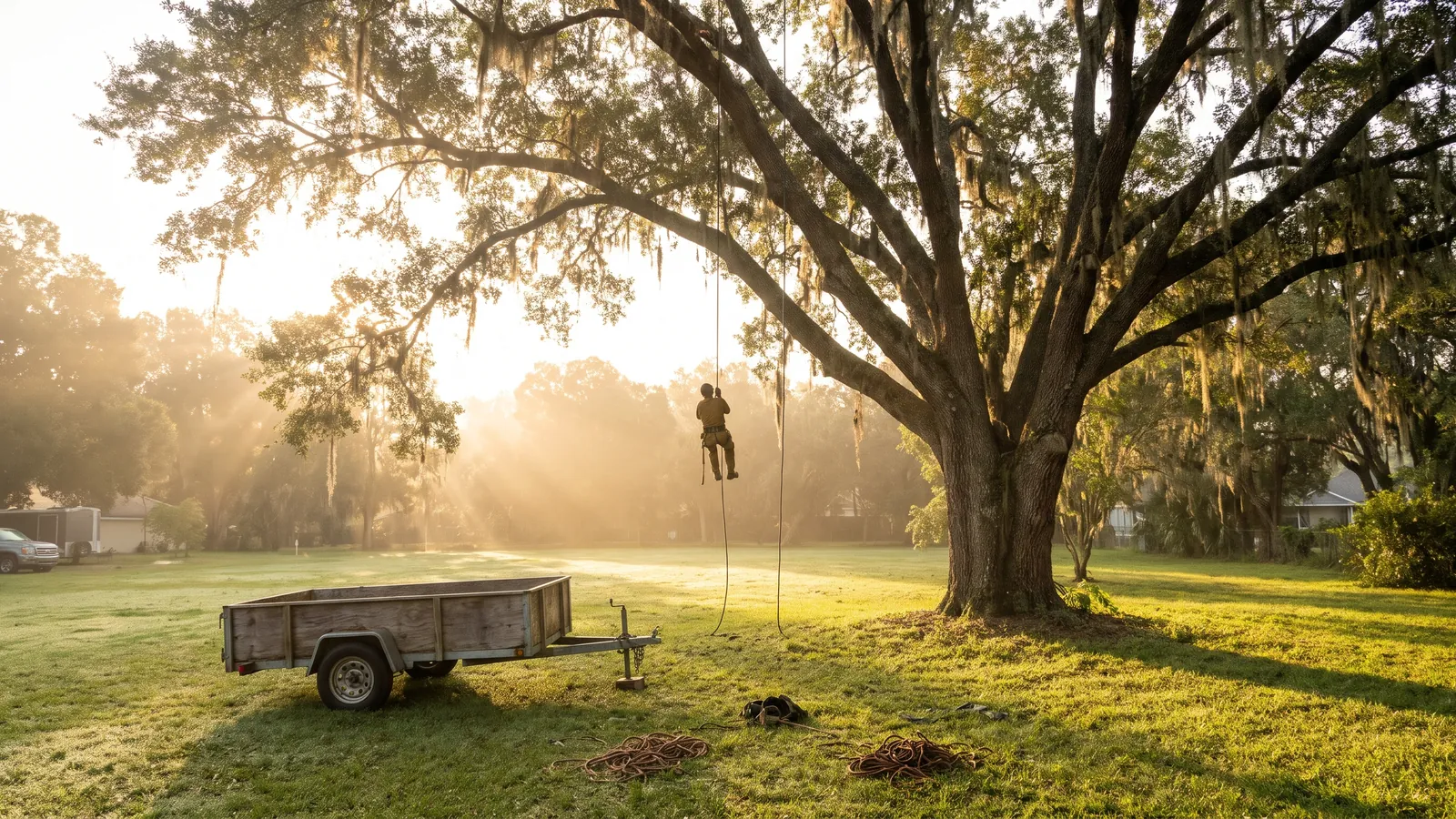
A tree above a house is taken apart in sections and let down on ropes. Palms get hauled off instead of chipped. Stumps are ground only after 811 has marked the lines in the yard, and the grass is raked at the end. When we leave, the only sign of the job should be more open sky.
Pruning follows ANSI A300
Each cut is made at the branch collar, and we take less than a quarter of the live crown. We do not top trees, we do not lion-tail them, and we do not give palms a hurricane cut. A badly pruned tree tends to fail in the next storm, so we turn that kind of work down even if someone told you it was what the tree needed.
Someone picks up at any hour
Storms here arrive at all hours, not during office time. If a limb comes through your roof at 2 AM, a person takes the call and a crew is sent out in order of priority; the paperwork waits until the tree is off the house. Crews work Monday through Saturday, and an estimate visit is usually set for within a day or two.