Hurricane tree prep in Polk County — what six storms taught us
Three hurricane eyes crossed southern Polk in six weeks in 2004. Irma, Ian and Milton followed. The trees that failed were predictable, and the prep that works is simple — if it's done in May.
What the storms did
- 2004: Charley (Aug 13), Frances (Sept 5), Jeanne (Sept 26)Three eyes within about two miles of each other in southern Polk in six weeks. Charley gusted 58 mph at Lakeland, 79 at Haines City, 75 at Lake Wales; Jeanne put 77 mph on Bartow and 7–8 inches of rain on Lakeland, and the Peace River set a record crest at Bartow. The storms that defined what 'hurricane prep' means here.
- 2017: Irma (Sept 10–11)Crossed Polk as a Category 2 with gusts around 115 mph near Mulberry and Lakeland. Eight of ten Polk homes lost power; Lakeland Electric took 15 days to restore most; 2,700-plus structures damaged.
- 2022: Ian (Sept 28–29)Gust of at least 78 mph at Lakeland Linder before the anemometer broke; 63,000 Lakeland Electric customers out; the big oaks along Lake Hollingsworth and Lake Morton came down; power back by October 4.
- 2024: Milton (Oct 9–10)76 mph gust at Lakeland Linder, 87 at Winter Haven, 80–90 across the county; 8.93 inches at the airport and more than 12 in the city in 24 hours — a '1-in-1,000-year' rain; 45-plus tornadoes statewide; 86,700 of Lakeland Electric's 138,664 customers out, 90 percent back by October 13; 455 structures affected; 200,000–250,000 cubic yards of vegetative debris in the city and 545,000 in unincorporated Polk.
- 2025 and 2026 to dateNo Florida landfalls in 2025; none in Polk so far in 2026. The season runs June 1 to November 30 every year regardless.
Which trees survive
UF/IFAS studied tree failure across the 2004 storms and Ivan, and the results are the single most useful thing a Polk homeowner can know. Highest wind resistance: live oak, sand live oak, sabal (cabbage) palm, southern magnolia, bald cypress, crape myrtle. Medium-high: slash and longleaf pine, sweetgum. Medium-low: red maple, loblolly pine, camphor. Lowest: laurel oak, water oak, pecan, Chinese tallow, Washingtonia palm; queen palm is the least wind-resistant palm. In Ivan, live oaks survived at 91 percent, sabals 80, laurel oaks 77, water oaks 72, slash pines 72. The tree over your bedroom matters more than any other fact on this page, and the species decides most of it.
The May checklist
- Walk the property with someone who can tell a laurel oak from a live oak. Rank every tree: keep, prune, remove.
- Remove what's earned it. Dead and beetle-killed pines, hollow laurel oaks, leaning water oaks, bronzed palms, anything dead over a structure or the driveway. A scheduled removal in May costs half what the same tree costs as an emergency in October.
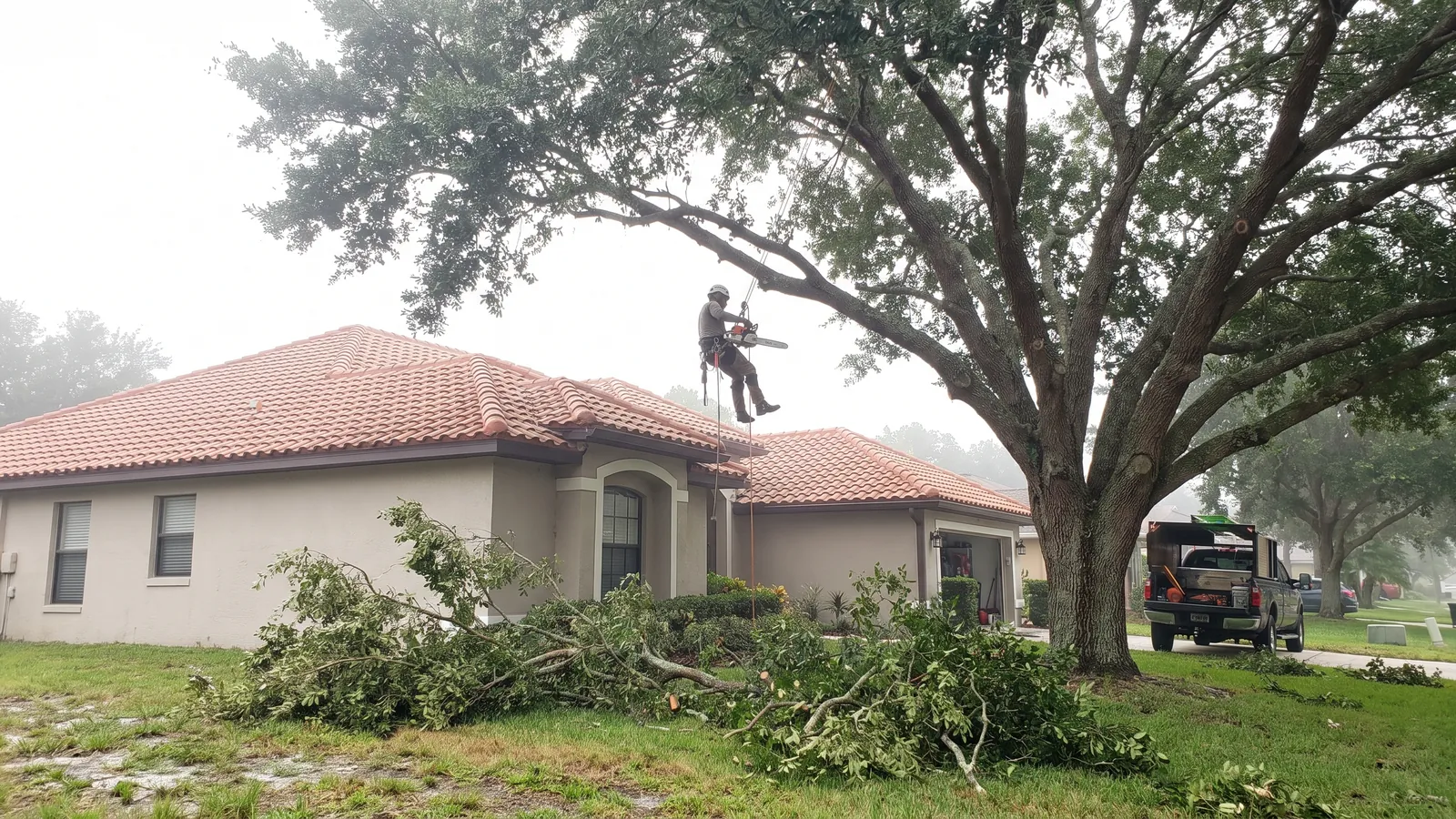
- Prune the keepers right. Deadwood out of the oaks; crowns thinned so wind passes through; over-extended limbs over the roof shortened to a lateral; palms cleaned of dead fronds and seed pods only. No topping, no lion-tailing, no hurricane cuts.
- Check the roots. Trees next to a recent driveway, pool, septic or utility trench have lost roots and may not stand up in saturated ground — Milton's twelve inches of rain is why so many heaved.
- Clear the lines. Limbs over the service drop from the pole to the house are yours to clear; the utility handles the main lines.
- Know your debris rules. Lakeland's curbside piles after a declared storm are limited to 6×4×4 feet; the county runs its own program. Keep the city hotline (863-834-TREE) and Lakeland Electric's downed-line number (863-834-4248) somewhere you'll find them.
Pruning that helps and pruning that hurts
Helps: selective crown thinning (removing a third of the interior branches so wind moves through), crown raising for clearance, reducing the length of overextended limbs by cutting back to a lateral branch at least a third the size, and removing dead wood. Hurts: topping (stubs rot and push weak sprouts that break), lion-tailing (stripping the interior and leaving tufts at the tips, which loads the limb ends), over-thinning (more than a quarter of the live crown in a year stresses the tree), and the palm 'hurricane cut' (pruning above the horizontal, which weakens the trunk and the crown). If a crew offers to top your oak for storm safety, that's the moment to get a second opinion.
Common questions
When should I do hurricane prep?
March through May. Crews are available, oaks heal fast coming out of dormancy, and it's done before June 1. By August everyone is calling; by October it's too late.
Should I take down every tall pine near my house?
No. A healthy slash pine with intact roots and no beetles is a reasonable risk and a medium-high wind-resistance species. One with root damage, a lightning scar, pitch tubes or fading needles is not. The walk sorts them.
Is my live oak safe in a hurricane?
Usually — it's the most wind-resistant tree in Florida. What fails on a live oak is dead wood and over-extended limbs, which pruning fixes, and a root plate compromised by construction, which it doesn't. Ian still took big oaks along Lake Hollingsworth, mostly ones with those problems.
Will insurance pay for prep?
No; it's maintenance. But the dead pine removed in May never becomes a hurricane deductible and a new roof in October.
What do I do the morning after?
Stay away from downed lines (863-834-4248 for Lakeland Electric), photograph everything before anyone cuts, call us for trees on structures and blocked access, and cut yard debris to the city's size limits for the curbside pickup.
Related: Hurricane tree preparation · Emergency tree service · Storm cleanup · Oak care